
By Ted Hausotter
Many of us started extract brewing because it is faster and easier than all-grain brewing. It is never more evident than when you brew four extract brews while making just one decoction mash all-grain brew!
In this article, we will explore how four different wheat liquid malt extracts (LME) compare to each other, and of course to the Grain Snob’s all-grain brew. To get a fair comparison, they were all brewed to the same style, German weizen. The extracts were not chosen on how well they fit the style, but were based on availability. Some of the LME will do better in other beer styles and should not be overlooked if they did not fare well in this taste-off.
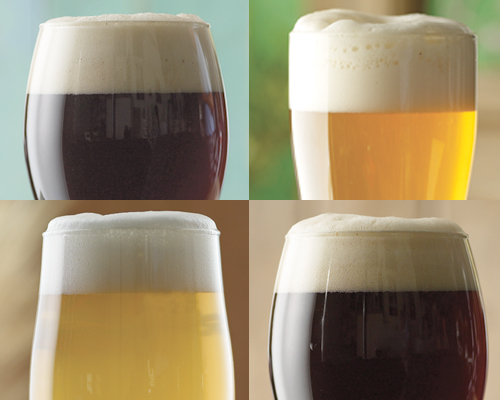
German weizen is a bready blond beer with a unique yeast profile that gives it a spicy clove and banana aroma and flavor. It can remind the drinker of eating a piece of banana bread, but usually not with any caramel or deep toasted notes. The malt is reserved, having a pleasant and inviting balance among the malt, clove and banana flavors. Weizens are simple drinking beers, so the alcohol level should be moderate; a beer connoisseur should be able to drink more than one glass.
The original gravity range from the BJCP guidelines is 1.044 to 1.052. Carbonation can be high and the head often extends above the rim of the glass. It is common for German weizens to be cloudy from yeast and protein in suspension, but krystal versions that are clear can also be found. For color, weizens are pale straw to deep gold. By German law, when brewed in Germany, they need to have at least 50-percent wheat malt to be called a weizen.
For the German weizen brew-off, the recipe was simple, with the brewing time for the extract beers taking just over one hour, not including cleanup and preparation. For malt, two cans of LME were used in each beer; no additional character grains or malt were added. The malt varieties for the extract beers included Coopers, Muntons, Briess and Alexander’s. The all-grain beer was brewed with German Pilsner malt and American wheat malt. The hop addition was the same for all five beers: 1.3 ounce of Mount Hood for 30 minutes. The only difference in all aspects of brewing after mashing is the amount of boil and cooling methods. All the extracts had 2 gallons of wort boiled and then cooled with the addition of cold tap water. To finish cooling them to proper pitching temperature, a wet towel was placed around the carboy.
The all-grain beer was a full 5-gallon boil. This did extract more hop bitterness. The original gravity of the all-grain beer was increased to match the first two extract beers’ gravity. It was chilled with a counter flow chiller to pitching temperature. In mashing the all-grain beer, it did become stuck and the mash bed was loosened up with whole hops, which transferred into the flavor of the beer.
The Tasting
Prior to tasting the beers, our preconceived thoughts were that the extract beers would not be as good as the all-grain beer, and the extract beers would all be similar while the all-grain beer would stand out. To make sure that all beers had an equal chance, they were poured into pitchers, given a number and then served blind at a Good Libations beer club meeting. All the members, which included three BJCP beer judges (Certified, National and Grand Master), filled out scoresheets on the beers. The results were shocking.
If you have never brewed a German wheat beer, they do take quite a flavor ride over their lifetime, with large swings when they are young. Initially at kegging, the all-grain beer was the best by far. No hop flavor was noted at kegging and just lightly at the first tasting. It grew to moderate levels at the second tasting. Alexander’s reminded us of a weizen bock at kegging, while at the tasting it did not have any bock character, but tasted like an American wheat beer with very light clove and banana character. Others were almost Belgian-like at kegging, a quality that completely disappeared at both tastings. The best advice is to taste them often and drink when you enjoy them.
In the following, you will find malt information from the manufacturer and compiled tasting notes with a ranking of how the beers scored on a 0 to 50 scale. They would be different with a change in technique or brewed to another beer style, so use it as a guide; it is not definitive. Most of the beers were judged twice in a fashion where the judges had no knowledge of the beer. The first judging was 10 days after fermentation was complete. The second judging was 15 days later.
All-Grain
First Tasting
Score 34, second place.Best German Pilsner malt and Great Western American Wheat malt.
- Original Gravity (OG) 1.057, Final Gravity (FG) 1.014.
- Aroma: Moderate sweet malt, zesty wheat. Low levels of medium ripe bananas. Spicy light clove aroma.
- Appearance: Medium gold and hazy with a nice off-white head that has good retention.
- Flavor: Clove and sweet malty bread notes, banana not as evident as in aroma. Lemon peel comes out as the beer warms and vents.
- Body: Medium body and carbonation.
- Overall: The all-grain beer is very drinkable, with a good German weizen profile. It does not hold up as well as it warms when compared to Coopers wheat beer.
Second Tasting
Score 27, tie for third place.
This beer changed a lot in 15 days. The lemon peel flavor from the hops found prior is very low, now melding into a more pungent and sometimes spicy hop flavor. It has the best haze at the second tasting. The bitterness balance is off; it is too high, masking the malt, banana and clove flavor balance. This beer should develop as the hops continue to fade over time and come into balance.
Coopers
First Tasting
Score 37.3, first place. All malt with 50-percent wheat malt. It is packaged in 3.3-pound cans.
- OG 1.055, FG 1.014.Country of origin for the malt is Australia.
- Aroma: Gentle overall, well balanced among all aspects of the aroma. Moderate malt that shows a wheat bread character. Light clove and banana aromas round out an inviting aroma profile.
- Appearance: Color is medium gold and clarity is hazy.
- Flavor: Moderate bready flavor with a lighter banana ester. Clove is low but grows as the beer vents and warms.
- Body: Medium body and carbonation.
- Overall: This is a drinkable beer that invites drinkers to take another sip until they notice it is time to refill!
Second Tasting
Score 36, first place by a wide margin.
Differences in profile from the first tasting are that the sweet-to-bitter balance is a touch on the sweet side, and now has brilliant clarity. It still draws the drinker into the second glass. Overall, the malt, banana and clove flavors are well balanced and intriguing.
Muntons
First Tasting
Score 27, fifth place. All malt with 55-percent wheat malt. It is packaged in 3.3-pound cans.
- OG 1.055, FG 1.014. Country of origin for the malt is England.
- Aroma: Moderate sulfur notes that vent fairly quickly and settle to a low level. Clove is found at lower levels than most. Moderate fresh apple esters. Malt is sweet with some caramel, similar to brown sugar.
- Appearance: Dark gold in color, hazy.
- Flavor: Fresh apple greets the drinker followed by very light clove, the second-lightest of the group. No banana esters noted, which is surprising. Wheat character is low.
- Body: It has the thinnest body of the group.
Second Tasting
Score 30, second place.
Sulfur still found but at lighter levels. Clove aroma comes out at stronger levels with the decrease in sulfur. Banana esters are now found at a light level. Clarity is now clear, almost brilliant. Apple esters are also lighter. Overall this beer is out of balance, with the malt flavors not flowing with the yeast character. A good beer in its own right, just not a great German weizen. Look to other styles such as English summer beers or American wheat beer for this malt.
Briess
First Tasting
Score 31, third place.
- All malt with 65-percent wheat malt. It is packaged in 3.3-pound cans.
- OG 1.048, FG 1.013.
- Country of origin for the malt is USA.
- Aroma: Light clove and green banana with a nice bready wheat character and bread crusts. Clove phenol morphs to a slight medicinal aroma.
- Appearance: Dark amber and hazy.
- Flavor: The medicine phenols were not found in flavor, only light clove phenol. The malt is bready. Green banana and light fresh apple esters are noted. Finish is dry.
- Body: Medium light body and medium carbonation.
Second Tasting
Score 27, tie for third place.
Medicine aroma was not noted at all during this tasting. Very light apple still noted. Overall the beer did not flow; it was a bit edgy with aspects of the beer fighting for attention, not melding together. Try this malt in an American wheat or try a different German weizen yeast strain.
Alexander’s
First Tasting
Score 29, fourth place.
Don’t let the low score fool you. This malt is just made for American wheat beer; it shouts through the German yeast saying that it wants to be an American wheat beer. It is all malt with 60-percent wheat malt and packaged in 4-pound cans.
- OG 1.063, FG 1.019. Country of origin for the malt is USA. The Alexander’s beer came out with the highest original gravity due to the cans being 0.7-pound heavier than the rest.
- Aroma: Medium high levels of sulfur that fade fairly quickly to moderate to low level. Malt has a bready wheat aroma with very light clove and banana.
- Appearance: Medium gold color with light haze.
- Flavor: Sweet malt with nice wheat character. Very light banana found, but no clove.
- Body: Medium body and carbonation. This malt is better suited as an American wheat beer.
Second Tasting
None.
Prior to the second tasting, jalapeño spices were added to the Alexander’s beer as the second tasting was not planned. In evaluating it at the second tasting, the sulfur notes were not noted and the new pepper character is pleasant. This malt will also do well as a base malt for spice beers.A special thanks to Wyeast Laboratories, Brew Craft and Alexander’s for donating supplies for the German weizen brew-off!
German Extract Brew Off
Ingredients for 5 U.S. gallons (19 liters)
- 2 cans malt extract (LME)
- 1.3 oz (37 g) Mount Hood hops, 4.9% a.a. (30 min)
- (1) 3068 Wyeast Weihenstephan Weizen yeast
- OG: 1.048 to 1.063 (varies with manufacturer of LME)
- IBU: 14
Grain Snob German Wheat – All-Grain Recipe
Ingredients for 5 U.S. gallons (19 liters)
- 3.5 lb (1.5 kg) German pilsner malt
- 4.5 lb (2.04 kg) Wheat malt
- 1.3 oz (37 g) Mount Hood hops, 4.9% a.a. (30 min)
- 1 3068 Wyeast Weihenstephan Weizen yeast
- Original Gravity: 1.048 IBU: 14Efficiency: 80%
Directions
Step or decoction mash with rests at 111° F (44° C), 122° F (50° C), 148° F (64° C) and 158° F (70° C) Sparge till runoff is 1.010 to 1.015. If needed, add rice hulls to loosen up the mash. Boil for 60 minutes and cool to 70° F (21° C). Pitch yeast.
Ted Hausotter is an award-winning homebrewer from Baker City, Ore. and the Mountain/Northwest regional representative for the Beer Judge Certification Program.
Share Post